
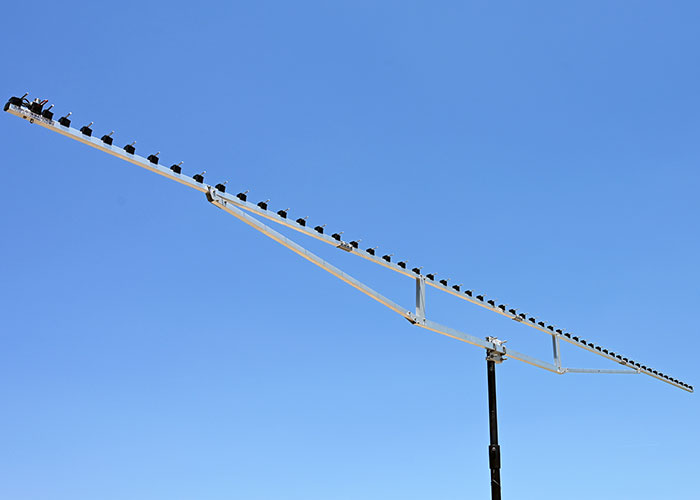
Super Gain 1296 MHz Yagi with 56 Elements 23cm56AUTHD
Powerful and durable antenna designed for high wind locations 23cm56AUTHD. The antenna can withstand a gust of winds up to 150 km/h! Designed with full 3D Electromagnetic Simulation Software including the influence of the boom, bracket, baluns, and connectors.
The 56-element 1296 MHz Heavy Duty Antenna has reinforced construction that helps keep the antenna always straight. 23cm56AUTHD plain view of the antenna:
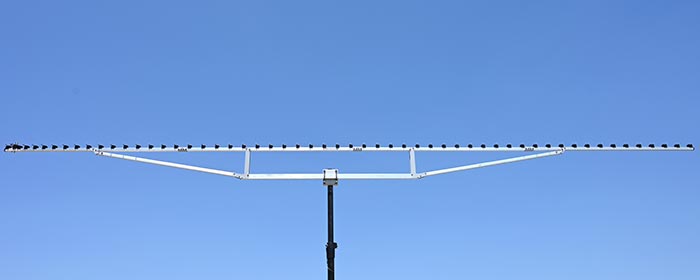
What does 23cm56AUTHD mean?
23cm – Frequency range from 1290 to 1310 MHz with low SWR
56 – Elements
A – Max Package size <120 cm. Can fit in an airplane as “baggage”
UT – UT141 or similar Teflon cable
HD – Heavy Duty construction antenna
Easy to put on the top of any mast. You do not need to worry about whether it is fiberglass or not since antenna elements will be higher. Any pipe from 40 to 70 mm will be good.
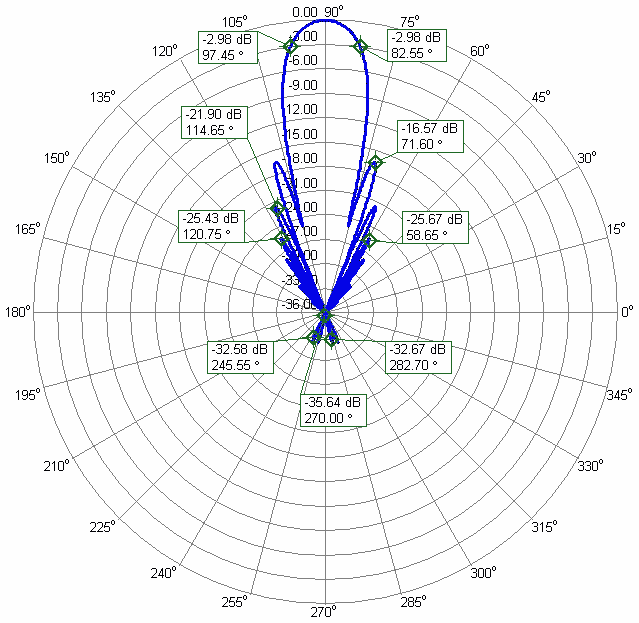
The 23cm56AUTHD old sign PA1296-56-4.7AUTHD antenna has exceptional gain for its size with 22.3 dBi and an immense front-to-back ratio of 35 dB.
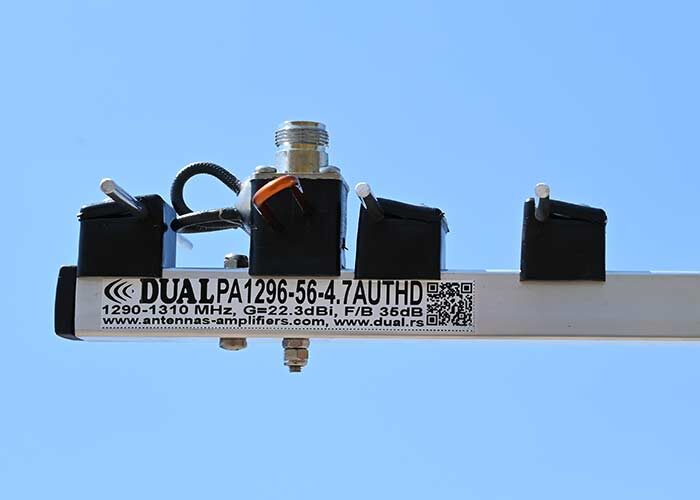
23cm56AUTHD versions:
1. Default 1290 – 1310 MHz designed for terrestrial and EME communication.
2. Wideband 1240 – 1310 MHz. Covers a full 23cm band. Some of the more common modes include voice, data, EME (moonbounce), as well as ATV.
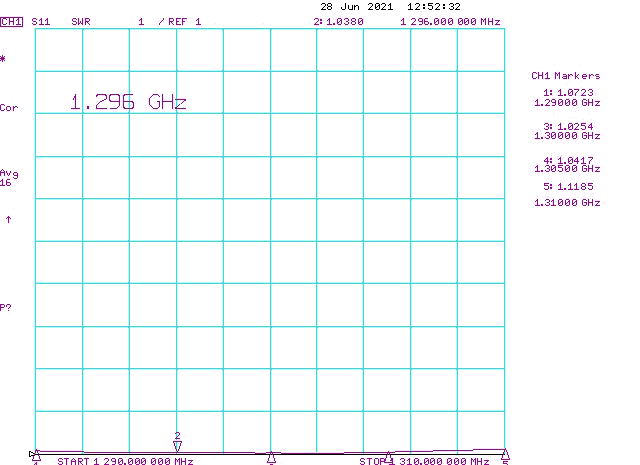
Measurement of 23cm Heavy Duty Antenna with 56 Elements 23cm56AUTHD
Electrical Specifications of 23cm56AUTHD
Frequency Range: 1290 – 1310 MHz (or 1240 – 1310 MHz by request)
Free Space Forward Gain: 22.3 dBi
Front-to-Back Ratio: 35 dB
-3 dB Horizontal Beam-width: 14.9°
Polarization: Horizontal
Nominal Input Impedance: 50 Ohms
SWR Across Entire Band: < 1.2
Maximum Power Input: 300 W
Matching Method: Voltage balun. UT141 or similar Teflon cable
Connector: “N”
Mechanical Specifications of 23cm56AUTHD
Number of Elements: 56
Element Diameter: 4 mm Aluminum rod
Dipole Diameter: 3 mm Copper
Longest Element: 120 mm
Element Mounting Position: Above the boom
Balun and Connectors: Included
Boom Length: 4.7 m
Boom Size: 20×20 mm with 20 x 30 mm heavy-duty support
The number of Boom Pieces: 4
Mounting Mast Diameter: 40 – 70 mm 1-11/16″ – 2-3/4″ OD
Clamp: M8 Stainless Steel
Survival Wind Speed: 150 km/h
Net Weight: 4.8 kg
Gross Weight: 6 kg
Transportation Length: 1.2 m
View from behind:
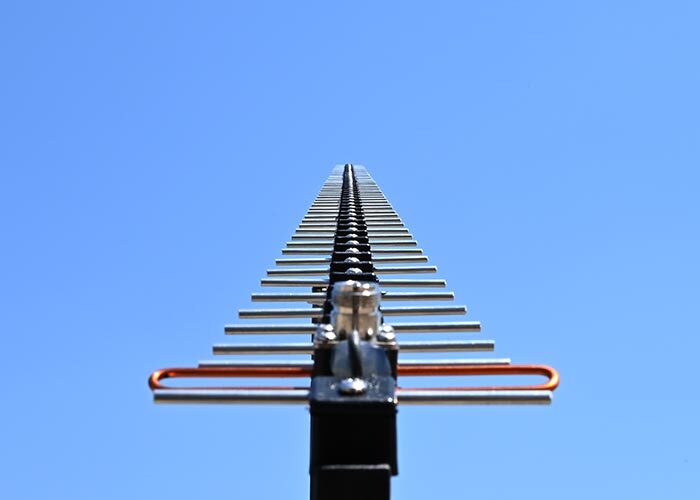
The antenna is 4.7 meters long and has a similar design to our shorter and longer HD versions.
– 43 Elements on the 3.6-meter boom. Heavy duty antenna PA1296-43-3.6AUTHD
– 70 Elements on the 6-meter boom. Heavy duty antenna PA1296-70-6AUTHD.
The 23cm56AUTHD has a similar construction as our PA1296-70-6AUT antenna. A YouTube video about construction and how to assemble is here.
View all our 23 cm antennas here.
More about Antennas-Amplifiers
Antennas-Amplifiers Product Benefits. A Major advance in Amateur Radio antenna design.
- F/B and G/T superiority.
All antennas have been calculated using state-of-the-art full 3D Electromagnetic Simulation Software including the influence of the boom, bracket, baluns, and connectors. The performance of antennas designed using these techniques is exceptional, far better than antennas designed using “wire” programs.
- No tuning antennas
Before dispatch, we assemble every antenna and test antenna characteristics. That means you may expect exceptionally good electrical and mechanical characteristics including low SWR across the designed range immediately after assembling.
No need to move the dipole, cut, or tune any element to get perfect SWR on the intended frequency range. Everything is pre-tuned.
That lead also to another very important detail. When assembled and tested each antenna is complete with all washers, nuts, bolts guy rope supports, etc.
When packing all parts are already on the antenna without the possibility of “forgetting” important parts to put in the box. So you will always receive the complete antenna we tested just before dispatching.
- Designs that work well in all weather conditions
- Low SWR and superior G/T, F/B, and F/S ratios across the entire bands
- Excellent mechanical properties
- High durability, built without compromise
Why is all the above so important? Why do we not use free wire programs like EZNEC (Pro), 4NEC2, MMANA-GAL, or AO, like all other producers or simulators?
EZNEC, 4nec2, or AO producers or simulators put on the web pages excellent “simulated” antenna patterns produced by wire programs. Looks good on a computer screen. But what about reality?
Elements are not infinitesimally thin.
The boom size is not 0 (zero) mm.
Boom correction programs exist. But what about accuracy?
Electrical terminals from balun coaxial cable to dipole are probably at least 10 mm long which is not “simulated” 0 (zero) mm. It will lead to worsening SWR or when tuned to good SWR to sharp antenna resonance.
Real antennas are not in free space. They are surrounded by metal parts not calculated in any form by wire programs.
Errors made by programs like EZNEC (Pro), 4NEC2, MMANA-GAL, AO, etc., only for the above examples are unacceptable these days. They will lead to wrong antenna gain, especially F/B. At least 5-15 dB lower than predicted. That means if the antenna is “calculated” for F/B 30 dB it could be anywhere between 15dB to 25 dB. Unfortunately, that also means the antenna will have much worse G/T which will lead to bad contest results and poor EME reception.
This has nothing to do with the obtained SWR of 1: 1 on an antenna. SWR 1:1 is not related in any circumstances to antenna gain, F/B, or G/T.
Hannes –
Hi
Last week I had the chance to install the antennas. As announced I moved the support construction back to the rear end of the antenna. I measured the SWR before and after the modification – no change.
I have been active on EME 2m (not anymore, too noisy here), 70cm and 23cm for over 30 years so I think I have some experience with that.
The yagis are connected by 1,1m Ecoflex 15 to the power splitter which is directly attached by an N-male flange connector to an old HF2000 relays. The LNA is also directly connected to the relays by an N-male flange connector. The LNA is a homebrew construction with a MG4919G HEMT.
Results/differences to the old the old 55 element F9FT
– massive construction, heavier, very stable. I had to replace the pipe holding the antennas
– SWR ~1:1,1 – good.
– beacons as expected
– ground to cold sky clearly better
– sun/cold sky @10cm-flux 180 measured 7,8dB. Thats pretty good.
– echo tests: excellent, best -23 on WSJT with about 500W at the antennas / 250W each, never saw before
– Saturday to Monday/today 19 contacts, smallest 2,6m dish 300W
This morning I set the stacking distance to 85cm so the G/T should be better
I am also thinking about replacing the old 2m CueDee 15 element yagis…
73s regards Hannes OE3JPC
Hannes –
After using 2x56el. 23cm56AUTHD (old PA1296-56-4.7AUTHD) for 10 months, another feedback.
The gain is at least 2dB, maybe 3dB higher than 2x55el Tonna, on the RX side the improvement is 4 to 5dB on EME due to the better pattern / G/T.
The phase error of the stacked antennas is less than 0,3 degrees (veryfied by various measurements of the sun noise) and I use 1.1m 1/2″ Cellflex phasing lines. Therefore the dB values should be real.
The shift of the support boom and the mast clamps towards the rear end obviously has no impact on the performance.
So far, I worked about 120 different stations on 23cm which is impressive keeping in mind my linear polarisation – almost 50% (the tougher ones!) with 2x56el.
Plus I won the Austrian UHF championship 2024 single operator thanks to lots of points on 23cm…
73s Hannes OE3JPC
Hannes –
After 2 years of intensive use and after a lot of tweaking of the rx side my current score on 23cm EME is 225 different stations.
The pattern and the gain of the 2×56 element Yagis (linear polarisation) is excellent and competitive with a 1,8m or 2m dish/circular polarisation. Ground/cold sky is 5,2dB (at least, I cannot turn the antenna down below -3°).
Well done – great job!
73s Hannes OE3JPC