
Universal HF 1:1 Common Mode Choke 10kW Balun Five Cores
Five Cores Universal HF 1-1 Common Mode Choke 10kW Balun for Bands 40m, 30m, 20m, 17m, 15m, 12m, and 10m. For Yagi antennas, dipoles, and verticals. High common-mode impedance and extreme power rating are the key features. This balun could easily handle any linear amplifier with a single, two, or three FU728F, GU84, GS35B, or MRF1K5, BLF188, ART1K6, ART1K9, ART2K5.
Why should you use a Common Mode Choke – Current Balun?
In transmitting antenna systems, common-mode currents can negatively impact antenna efficiency, reduce gain, distort the antenna pattern, and increase local radio frequency interference (RFI).
In receiving systems, common-mode currents may raise the noise floor, distort audio signals, cause computer crashes, or potentially result in RF burns.
A high-quality common-mode choke or current balun features high common-mode impedance. This high impedance helps to minimize unwanted currents to nearly undetectable levels. A general guideline suggests aiming for a common mode impedance of 500 Ohms or higher for 50 Ohm transmission lines.
Balun uses 10mm Teflon RG115 cable to withstand high power and tolerate SWR.
Universal HF 1-1 Common Mode Choke 10kW Balun 7-30MHz Appearance:
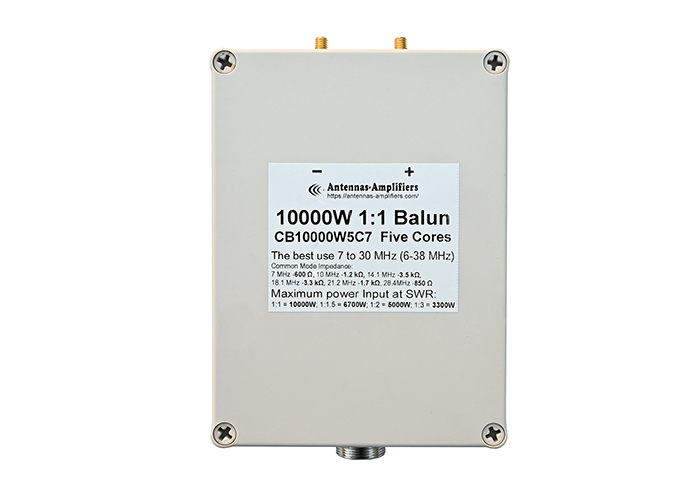
Use this Universal HF 1-1 Common Mode Choke 10kW Balun 7-30MHz to:
- Increase antenna efficiency
- Increase antenna gain
- Clean antenna pattern
- Lower RFI
- Lower receive noise
Universal HF 1-1 Common Mode Choke 10kW Balun could be produced in two versions:
- SKU: 2987 Universal HF 1:1 Common Mode Choke 10kW Balun CB10000W5C7 7/16 DIN connector (this one)
- By order with Plain Brass Hex Nuts or Wing Nuts (no price change)
- SKU: 2988 InLine HF 1:1 Common Mode Choke 10kW CB10000W5C72 (both sides 7/16 DIN connector +15EUR)
Universal HF 1:1 Common Mode Choke 10000W Balun 7-30MHz Appearance:
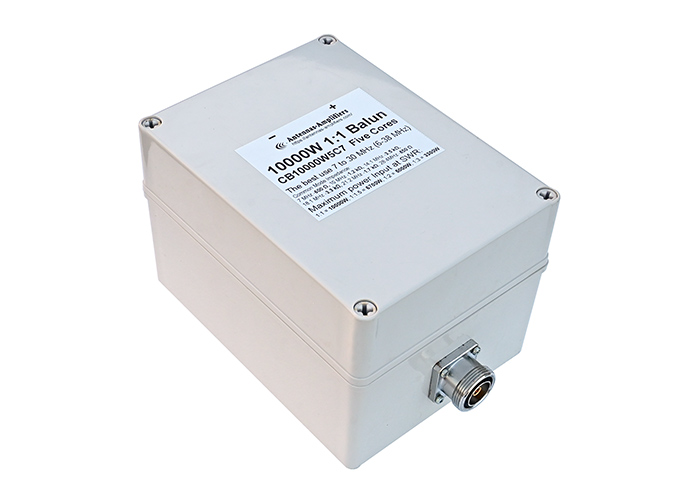
Measured common mode impedance of 1:1 Common Mode Choke 10kW:
- 6.3MHz 500Ω
- 7.1MHz 600Ω
- 10.1MHz 1.12kΩ
- 14.1MHz 3.5kΩ
- 18.1MHz 3.3kΩ
- 21.2MHz 1.7kΩ
- 24.9MHz 1.2kΩ
- 28.4MHz 850Ω
- 38MHz 500Ω
- 50.1MHz 340Ω
Maximum power input at SWR:
1:1 = 10000 W; 1:1.5 = 6700 W; 1:2 = 5000 W; 1:3 = 3300 W
Weight 1.7kg
Size: 150x200x130mm
Produced with 5 pieces of the best ferrite cores
Cable used: RG115 10mm Teflon.
The other Common-Mode Chokes – baluns are here.
Customer questions:
Q1: Some antenna manufacturers claim that their antenna does not need a balun or “works very well without a balun“. Is it true?
A: If they can prove the non-existence of common-mode currents, that would be fine. However, this is impossible to confirm on any HF or VHF antenna.
Q1: Which antennas need a balun?
A: All dipoles, all Yagis, Quad antennas, and Vertical (GP) antennas. No exception.
Q3: But almost all Quad antenna producers claim that a Quad antenna does not need a balun. Is it true?1
A: Please read Q1 and Q2.
Q4: But I have a perfect 1:1 SWR on the antenna without a balun? Is it good?
A: YT1NT Quote: Without a balun, some of the transmitter power is lost. The resonance of the antenna is masked and distorted; what is actually measured is the resonance of the entire system, in which the shield of the coaxial cable functions as part of the antenna. The resonance of that system does not have to have anything to do with the resonance of the antenna itself, ie, the fact that we set the resonance of the system does not mean that the antenna is anywhere close to resonance, which can cause significant losses. This will lead to a weaker signal and a worse ranking in competitions.
Q5: I purchased a balun from a ham radio vendor, but it didn’t come with any common-mode impedance data. Is the balun good?
A: It could be, but that’s not guaranteed. The fact that the balun is available for purchase doesn’t necessarily mean it’s good. What truly matters is whether the common-mode impedance data has been measured at the frequencies of your interest. If you don’t have that information, you may have a problem. Or it might be unclear what you’ve actually bought.
Reviews
There are no reviews yet.